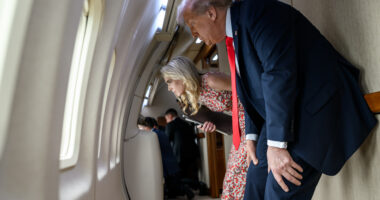
An unauthorized aircraft entering restricted airspace near President Donald Trump’s visit to South Carolina triggered a swift military response, with an F-16 fighter jet dispatched to intercept the plane as presidential security operations were underway. The incident occurred Wednesday, October 21, near Clemson, South Carolina, where Trump was scheduled to appear at a campaign rally ahead of the November midterm elections. According to the North American Aerospace Defense Command (NORAD), an F-16 intercepted the civilian aircraft at approximately 5:39 p.m. after it entered restricted airspace in the Clemson area. The response came just minutes before Air Force One arrived at Greenville-Spartanburg International Airport at approximately 5:46 p.m. Military officials said the civilian plane eventually landed safely at a nearby airfield while remaining under NORAD surveillance. Authorities did not publicly identify the pilot or indicate that the incident involved a deliberate attempt to threaten the president. Trump continued with his scheduled visit despite the airspace violation. After landing, he departed Air Force One and boarded Marine One, which transported him to the area near Clemson University’s T. Ed Garrison Arena. The helicopter arrived at approximately 6:33 p.m., and the president later addressed supporters at the rally. The incident highlighted the extensive precautions taken whenever the president travels to public events. Presidential visits often involve temporary flight restrictions established by the Federal Aviation Administration (FAA), limiting where civilian aircraft can operate around designated locations and during specific time periods. These restrictions are intended to protect the president, government officials and members of the public attending large gatherings. Pilots are responsible for checking applicable flight notices before taking off and ensuring their routes comply with any active restrictions. When an aircraft enters protected airspace without authorization, NORAD can dispatch military aircraft to investigate the situation. Fighter pilots may attempt to establish contact with the civilian pilot, signal that a violation has occurred and direct the aircraft away from the restricted area. In this case, the F-16 monitored the aircraft until it landed safely. Officials did not report any injuries or property damage connected to the incident. Following such encounters, NORAD reminds civilian pilots that they must respond promptly when intercepted by military aircraft. Pilots are expected to establish communication through designated emergency aviation frequencies, follow instructions from military personnel and leave restricted airspace as directed. Violations can lead to questioning by federal authorities and potential enforcement action, depending on the circumstances. Officials had not publicly disclosed whether the pilot involved in the South Carolina incident would face penalties. The interception also followed a separate incident involving Trump’s campaign travels. On October 17, NORAD fighter aircraft responded to a civilian plane that entered temporary restricted airspace near Cincinnati, Ohio, while the president was attending a rally at Northern Kentucky University. Military aircraft escorted that plane away from the protected area.…
Oil prices have climbed to their highest levels since May, adding to the financial pressure on American households as the war in Iran continues with little indication that the conflict will end soon. As of Friday morning, Brent crude, the international benchmark, was trading at approximately $116 a barrel. U.S. West Texas Intermediate crude had reached roughly $102 a barrel, reflecting the growing strain on global energy markets. The surge comes as the conflict approaches its eighth month, raising concerns about how long elevated energy costs could persist. Although ships continue to pass through the Strait of Hormuz, a critical route for global oil shipments, the risks associated with traveling through the region have driven up shipping expenses and added uncertainty to the oil market. American drivers are already feeling the effects at the pump. The national average for regular gasoline stood at approximately $4.29 per gallon on Friday, according to AAA. That figure was about 18 cents lower than a month earlier but remained roughly $1.22 above the price recorded at the same time last year. For President Donald Trump, the rising cost of energy presents a growing political challenge. Higher gasoline prices can quickly become a source of frustration for voters, particularly those who depend on their vehicles for work, family responsibilities and everyday errands. When fuel costs rise, households often have less money available for groceries, utilities and other expenses, increasing the sense that the economy is becoming harder to manage. That pressure could become especially damaging for Trump and Republican candidates as the midterm elections approach. Voters frequently judge the administration in power by the cost of living, and gasoline prices are among the most visible expenses Americans encounter. Even when international conflicts drive oil prices higher, the political consequences can fall on the president, who is expected to demonstrate that his administration can protect American interests while keeping household costs under control. The longer the war continues, the more difficult that message could become. If crude oil remains above $100 a barrel, gasoline prices could face renewed upward pressure, potentially erasing recent relief at the pump. Higher transportation costs can also affect businesses that depend on fuel to move products, creating the possibility that consumers will encounter rising prices in other areas of the economy. For Trump, the combination of an extended conflict, expensive oil and persistent pressure on family budgets risks undermining his economic message at a politically sensitive time. With voters preparing to decide control of Congress, the cost of filling up a vehicle could become another major test of public confidence in his leadership.