Trump’s 2024 Photo Comes Back To Haunt Him
Two years after Donald Trump used a dramatic grocery display at his New Jersey golf club to attack Democrats over inflation, the cost of everyday necessities is emerging as a potential problem for Republicans heading into the 2026 midterm elections.
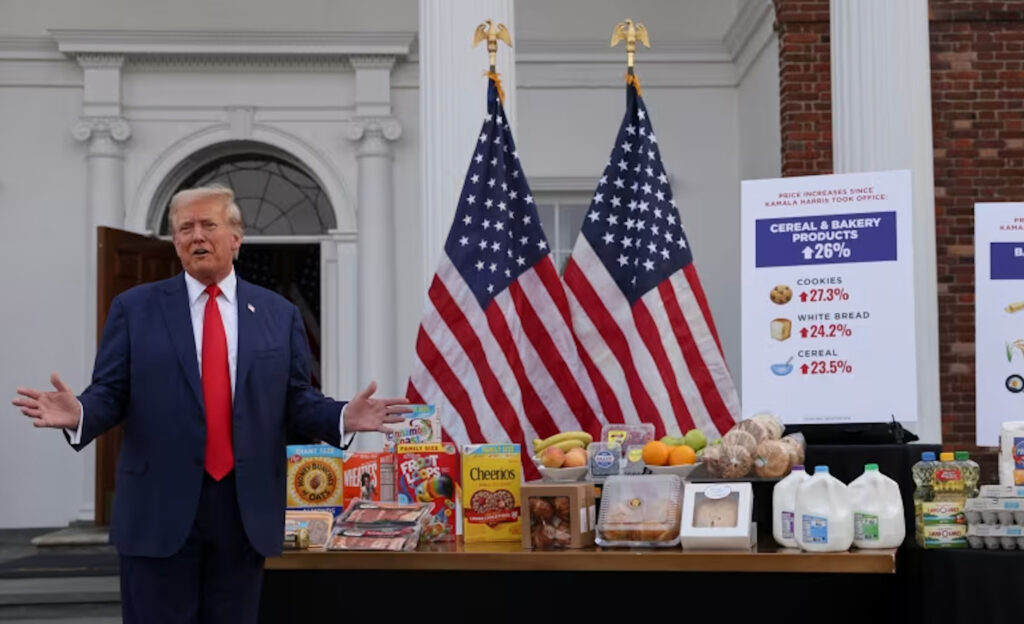
In August 2024, Trump stood before tables stacked with fruit, beef, cereal, milk and other household staples at his Bedminster club while criticizing the Biden administration for rising grocery prices. The event was designed to reinforce one of his central campaign promises: that a Trump presidency would bring down inflation and make life more affordable for American families.
Now, with the midterms approaching, voters continue to feel pressure from the cost of groceries and gasoline. Recent polling has shown that the economy and cost of living remain among the most important concerns for voters, while Democrats have gained an advantage in some measures of which party voters trust more on economic issues.
A review of 26 grocery categories tracked by the Bureau of Labor Statistics found that prices increased about 3.4% during the first 19 months of Trump’s second term. That pace was substantially slower than the increase during the comparable period under Biden, but prices for many of the products featured in Trump’s 2024 presentation have nevertheless moved higher.
Some of the biggest increases have come in categories that consumers notice quickly. Uncooked beef prices have risen more than 19%, coffee has increased nearly 23%, apples are up about 14%, and fresh fish and seafood have climbed roughly 9%.
There have also been notable declines. Egg prices have fallen sharply from their earlier highs, while butter, bacon and cooking fats and oils have also become less expensive. Egg prices have dropped nearly 40% during Trump’s second term, following a dramatic increase caused by avian flu-related shortages.
The White House has pointed to the recent inflation data as evidence that Trump’s economic agenda is working. Administration officials have highlighted falling costs for certain household expenses, along with stronger real wages, as signs that price pressures are easing.
But for many voters, the issue is less about whether inflation is slowing and more about what they are actually paying at the checkout counter.
That distinction could become increasingly important heading into November. A Reuters/Ipsos poll found Trump’s rating on his handling of the cost of living had deteriorated significantly compared with the beginning of his term, making affordability one of his weakest areas of public support.
Republicans are not abandoning Trump over the issue. Some voters continue to argue that prices remain elevated because of conditions inherited from the Biden administration, while others say issues such as immigration and education matter more to them than grocery costs.
Still, frustration over household expenses could create problems for Republicans in competitive congressional districts. Voters who supported Trump in 2024 but now feel financially squeezed could become less motivated to participate in the midterms or could reconsider how they vote.
Economists also caution against assigning responsibility for grocery prices entirely to the president. Food costs are influenced by numerous factors, including supply disruptions, commodity prices, labor expenses, weather, global events and broader economic conditions.
For Republicans, however, the political problem is straightforward: Trump made grocery prices a major campaign issue in 2024. As voters head back to the polls two years later, they now have a chance to compare those promises with what they see on their receipts.
And with gasoline prices also weighing on household budgets, the affordability debate could become one of the biggest challenges facing the GOP as the 2026 elections approach.