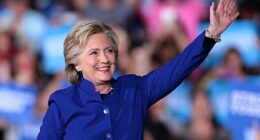
Trump Shocks Everyone With Election Win

Sen. Darline Graham, the candidate endorsed by President Donald Trump, won the Republican nomination Tuesday in the special election to fill the Senate seat left vacant following the death of her brother, Sen. Lindsey Graham, according to the Associated Press.
The victory gives Trump another notable win in a Republican primary and puts Darline Graham in a strong position heading into November. She will face Democrat Annie Andrews in the general election, but Republicans are heavily favored in South Carolina, where Democrats have not won a U.S. Senate race since 1998.
Graham, 62, defeated Rep. Ralph Norman after the two finished first and second in the Aug. 11 Republican primary. Because neither candidate received enough votes to win outright, they advanced to Tuesday’s runoff.
Graham entered the race July 20, shortly after Republican Gov. Henry McMaster appointed her to temporarily fill her late brother’s Senate seat. The appointment marked her first time holding elected office.
Her campaign received a major boost from Trump’s endorsement, as well as the Graham family name, which has been prominent in South Carolina politics for decades. Trump campaigned alongside her in the state Friday, while MAGA Inc. spent more than $827,000 on phone calls and text messages urging Republican voters to support her ahead of the runoff, according to Federal Election Commission filings.
The race was not without controversy for Graham. During a debate, she acknowledged that she was “not that informed on national security” when answering a question about U.S. policy toward Taiwan.
The comment immediately created a contrast with her late brother, who spent decades building a reputation as one of the Senate’s most prominent voices on foreign policy and national security.
Norman seized on the issue, arguing that South Carolina needs a senator with a stronger grasp of international affairs.
“South Carolina deserves a Senator who UNDERSTANDS Foreign Policy,” Norman wrote on X, while emphasizing his support for a “peace through strength” approach.
Norman, 73, positioned himself as the more experienced conservative throughout the campaign. A longtime House member and vice chair of the House Freedom Caucus, he argued that voters should focus on a candidate’s record rather than a famous political name.
Norman had also recently suffered a setback of his own, finishing third in South Carolina’s Republican gubernatorial primary in June behind Lt. Gov. Pamela Evette and state Attorney General Alan Wilson.
The Republican runoff became an expensive battle, with the two campaigns spending heavily to reach voters. Together, Graham and Norman spent more than $5 million on advertising during the runoff, according to AdImpact.
Graham’s campaign emphasized her alliance with Trump, while Norman portrayed himself as an established conservative who did not need political endorsements to prove where he stood.
With the Republican nomination now secured, Graham enters the November contest as the clear favorite. The outcome also provides another test of Trump’s ability to translate his endorsement into victories for candidates who are sometimes political newcomers.
For Graham, however, the next challenge will be convincing voters that she can step out of her brother’s enormous political shadow and establish her own record in the Senate.